
{UAH} Nobel Peace Prize for anti-rape activists Nadia Murad and Denis Mukwege
|
7:48 AM |
No comments |

Nobel Peace Prize for anti-rape activists Nadia Murad and Denis Mukwege
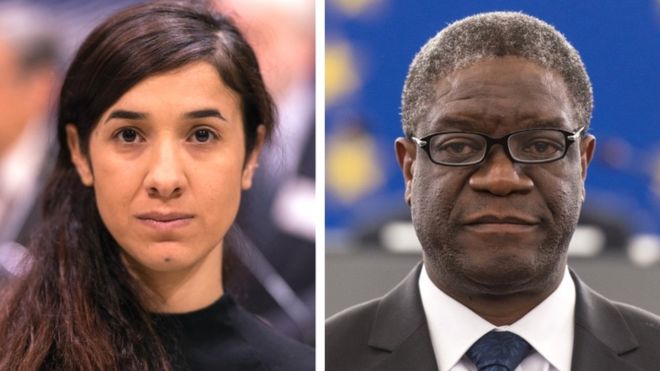 EPAMs Murad and Dr Mukwege made a "crucial contribution" to fighting violence against women
The 2018 Nobel Peace Prize has gone to campaigners against rape in warfare, Nadia Murad and Denis Mukwege.
Ms Murad is an Iraqi Yazidi who was tortured and raped by Islamic State militants and later became the face of a campaign to free the Yazidi people.
Dr Mukwege is a Congolese gynaecologist who, along with his colleagues, has treated tens of thousands of victims.
Some 331 individuals and organisations were nominated for the prestigious peace award this year.
The winners announced in the Norwegian capital Oslo on Friday won the award for their "efforts to end the use of sexual violence as a weapon of war", Berit Reiss-Andersen, the Nobel committee chair, said.
The pair both made a "crucial contribution to focusing attention on, and combating, such war crimes", Ms Reiss-Andersen added.
How have the winners reacted?
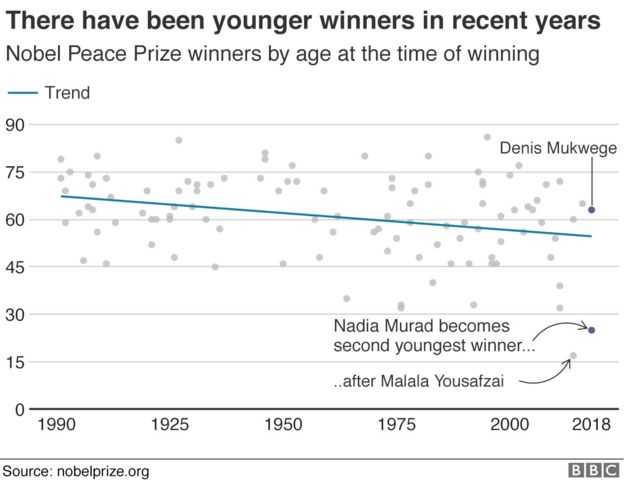
Ms Murad, 25, dedicated the award to her mother, who was killed by the Islamic State (IS) militants who overran their home in 2014.
She also dedicated it to the Yazidis and other Iraqis who were killed by IS, a spokeswoman for her foundation said.
New Iraqi President Barham Saleh called the award "an honour for all Iraqis who fought terrorism and bigotry".
Dr Mukwege was operating at his hospital when he heard he had won the prize.
"I was in the operating room so when they started to make noise around [it] I wasn't really thinking about what was going on, and suddenly some people came in and told me the news," he told Norwegian newspaper VG.
He dedicated his award to all women affected by sexual violence.
Who is Nadia Murad?
Ms Murad did not just lose her mother in the genocide. She endured three months as a sex slave at the hands of IS militants. She was bought and sold several times and subjected to sexual and physical abuse during her captivity.
After escaping, she became an activist for the Yazidi people, campaigning to help put an end to human trafficking and calling on the world to take a tougher line on rape as a weapon of war.
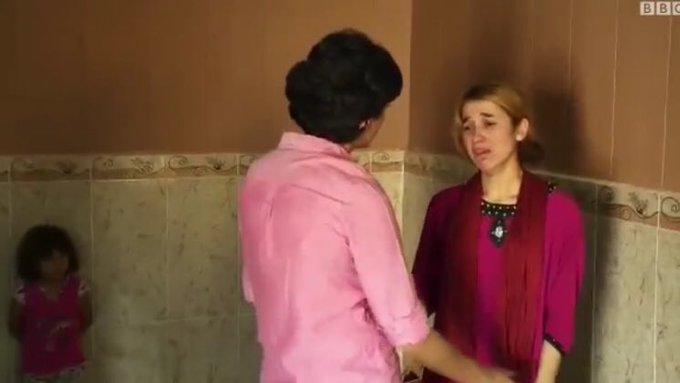
I met Nadia Murad just the day after she managed to escape from #Mosul. I told her we can film the interview anonymously but she refused, "No let the world see what happened to us" she said ... She is now a noble peace prize winner. #Yazidi #Izadi #NadiaMurad

End of Twitter post by @nafisehkBBC

Ms Murad described her escape in a BBC interview in 2016, detailing how the women who were held captive were treated by IS.
She was awarded the Vaclav Havel Human Rights Prize by the Council of Europe in 2016 and called for an international court to judge crimes committed by IS in her acceptance speech in Strasbourg.
Ms Murad, the first Iraqi to win the award, was named the UN's first goodwill ambassador for survivors of human trafficking later that year.
Who is Denis Mukwege?
He has spent decades helping rape victims in the Democratic Republic of Congo.
He and his colleagues are said to have treated about 30,000 rape victims, developing great expertise in the treatment of serious injuries sustained during sex assaults that were carried out as a weapon of war.
The 63-year-old has won a number of international prizes, including the 2008 UN Human Rights Prize, and was named African of the Year in 2009.
He lives under the permanent protection of UN peacekeepers at his hospital and has also previously called for a tougher line on rape as a weapon of war.

Denis Mukwege in his own words
It was in 1999 that our first rape victim was brought into the hospital. After being raped, bullets had been fired into her genitals and thighs.
I thought that was a barbaric act of war but the real shock came three months later. Forty-five women came to us with the same story, they were all saying: "People came into my village and raped me, tortured me."
Other women came to us with burns. They said that after they had been raped, chemicals had been poured on their genitals.
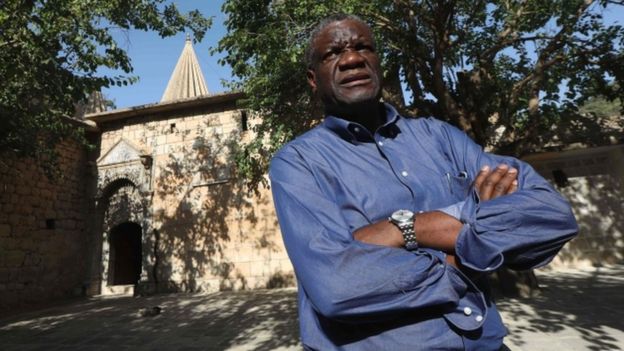 GETTY IMAGESDr Mukwege is an expert in the treatment of serious sexual injuries
I started to ask myself what was going on. These weren't just violent acts of war, but part of a strategy. You had situations where multiple people were raped at the same time, publicly - a whole village might be raped during the night. In doing this, they hurt not just the victims but the whole community, which they force to watch.
The result of this strategy is that people are forced to flee their villages, abandon their fields, their resources, everything. It's very effective.
Who else won a Nobel award this year?
Earlier this week the Nobel prize for physics was awarded to Donna Strickland, only the third woman winner of the award and the first in 55 years. The Canadian was honoured along with Arthur Ashkin, from the US, and Gerard Mourou, from France.
The Nobel prize for medicine was awarded to two scientists - Professor James P Allison from the US and Professor Tasuku Honjo from Japan - who discovered how to fight cancer using the body's immune system.
For chemistry, the prize was awarded to three scientists for their discoveries in enzyme research. Americans Frances Arnold and George P Smith shared the prize with Briton Gregory Winter
How is the prize decided?
- Eligible nominators from around the world can put forward candidates up to 1 February of the award year, while Nobel Committee members have more time
- All nominations are reviewed by the committee - whose five members are chosen by the Norwegian parliament - before a shortlist of 20-30 candidates is selected
- A group of Norwegian and international advisers writes individual reports on the shortlisted candidates. Using these and further reports, the committee narrows the selection down to a handful
- A decision is reached in the last meeting of the committee, usually in late September or early October, before the prize is announced
- If a unanimous decision cannot be reached, a simple majority vote is used
- After the announcement, the award ceremony takes place on 10 December, the date of Alfred Nobel's death
- Previous winners include figures such as Nelson Mandela, Martin Luther King Jr, Mother Theresa and the Dalai Lama
- Last year the prize was won by the anti-nuclear weapons group International Campaign to Abolish Nuclear Weapons, a coalition of NGOs whose work has highlighted the humanitarian risk of such weapons

Disclaimer:Everyone posting to this Forum bears the sole responsibility for any legal consequences of his or her postings, and hence statements and facts must be presented responsibly. Your continued membership signifies that you agree to this disclaimer and pledge to abide by our Rules and Guidelines.To unsubscribe from this group, send email to: ugandans-at-heart+unsubscribe@googlegroups.com


0 comments:
Post a Comment