
{UAH} From Birmingham to Bangladesh: how new education courses are changing lives in Africa and Asia
|
12:34 PM |
No comments |

From Birmingham to Bangladesh: how new education courses are changing lives in Africa and Asia

Drawing on its experience of creating bespoke courses, The OU has designed award-winning programmes for students and teachers to enhance learning in remote and developing areas
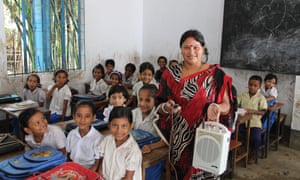
The Open University's (OU's) mission to provide access to education for all is a global one, extending to some of the world's poorest countries.
About half the children in the world will be unable to read, write or count by the end of their primary school years, according to the Unesco Institute for Statistics.
"That's around 300 million children – and the proportion rises to 75% in middle-income countries and 90% in low-income countries," says Tom Power, programme leader for international teacher education at the OU and director of the award-winning English In Action (EIA) programme.
"But it's well established that teachers are the single biggest determiner of children's learning outcomes, so the global crisis in children's learning actually reflects a wider crisis in teacher education."
Improving teaching practice – the ultimate purpose of EIA – is critical to tackling those statistics. For a decade, the programme has worked in partnership with government stakeholders, donors and NGOs in Bangladesh to design and deliver an innovative, high-impact teacher-development programme, funded by UK Aid and managed by Cambridge Education.
Power believes many professional development programmes for teachers are "too theoretical", with an emphasis on subject knowledge and pedagogy that is "quite abstract and removed" from the practical skills teachers in sub-Saharan Africa or south Asia need in the classroom.
Evaluation of prior programmes showed that while teachers understood principles of communicative language teaching (CLT), they did not put them into practice.
"Teachers did not think it was possible or relevant to apply what might work for 30 children in a class in Birmingham to their own classrooms of up to 120 children in Bangladesh."
However, providing teachers in remote rural classrooms with offline professional development resources – which guide teachers through practical classroom activities, with support from the head and other teachers in school – has fundamentally changed the way they work.
The project has granted 43,000 primary teachers and 11,000 secondary teachers in Bangladesh access to audiovisual classroom resources and professional development tools via micro SD cards, plus printed materials. That equates to one-fifth of all primary teachers and almost half of all secondary English teachers in the country; they have enabled about 7 million children to learn English.
Data from thousands of teacher development meetings shows a "substantial shift" in teaching practices, with more than 70% of the programme's participants using the project's teacher development videos, and 80% carrying out the classroom activities each week.
In addition, EIA project staff observed 90% of teachers putting into practice what they had learned through the programme, with two-thirds communicating in class using English more-often than Bangla.
The students are learning too. "Typically, students went from speaking very rarely, to speaking for a quarter of the lesson, which is in line with international standards. Students and teachers in English language lessons also changed from speaking mostly in Bangla to mostly in English," explains Power.
"After less than 12 months, 59% of primary schoolchildren had passed an international test, while 52% of secondary schoolchildren had passed the next level."
In sub-Saharan Africa, an OU project started in 2005 by Prof Bob Moon, CBE, is achieving similar results. Teacher Education in Sub-Saharan Africa (TESSA) is a long-term project. Resources were developed collaboratively by a consortium of 14 institutions from nine African countries. The resources are free, linked to the curriculum, and help teachers plan engaging lessons.
"The availability of free, adaptable resources for teachers in the developing world is an enormous benefit," says Kris Stutchbury, senior lecturer in teacher education for the OU and academic director of the TESSA programme. "TESSA is not an intervention – the materials open up possibilities for teachers, providing ideas for them to use and adapt in their context."
"Each institution in the consortium took the pan-African version of the materials that we developed together, and made them contextually more relevant for their own country. There are now 10 versions, in four languages available on tessafrica.net.
"When we started, people wanted print copies of the materials, but as internet connectivity and access to smartphone technology improves across Africa, the project has the potential to reach more and more people," says Stutchbury.
Evaluation shows that using TESSA materials raises attendance, enhances the relationship between teachers and students, and improves outcomes for low-attaining students. Grant money is used to promote the use of TESSA materials through workshops, social media and online courses.
The OU has pioneered the use of Moocs (massive open online courses) in international development work. Available free of charge on the OU's FutureLearn platform, the Making Teacher Education Relevant for 21st Century Africa course has been accessed by 3,400 people across Africa. TESSA trained 140 local facilitators to support people studying the Mooc, and achieved a 37% completion rate. The OU recently won a PIEoneer digital innovation (learning) award for the TESSA Mooc.
To gauge the true impact of the OU's international development work, Power tells the story of a teacher he encountered at a remote rural school in Africa.
"Far from the end of the tarmac, 160km into the bush, we met a headteacher doing remarkable things with literacy – making reading materials for everyone to take home, ensuring every child started the day with phonics regardless of their grade, and setting creative writing tasks for every child, which she read every Monday morning," he says.
"I found it so inspiring to see someone doing good things in such an incredibly remote place with no telephone signal and no water or electricity – the school's overall pass rate [in the end-of-primary-phase national exams] had gone from 16% the year before she was there to 53% the year after she arrived – but she was struggling with isolation."
In the last fortnight, the OU and World Vision International has brought her and a dozen other headteachers together as part of a new project to support Foundation literacy and numeracy.
"But it's not about starting more projects," says Power. "It's about helping connect the people doing extraordinary things against incredible odds, enabling a movement for change so that teaching has a practical impact in the classroom, improving outcomes for students throughout the world."
Sustainable change requires that people at all levels of the system work together towards a shared goal. From 9-12 September 2019, the OU will be co-hosting the Pan Commonwealth Forum for Open Learning with the Commonwealth of Learning, bringing together over 500 policy-makers and educators from across the globe to share learning on how open education can accelerate progress towards the achievement of the sustainable development goals. For more information on the OU's portfolio of award-winning international education projects, visit the OU website
Disclaimer:Everyone posting to this Forum bears the sole responsibility for any legal consequences of his or her postings, and hence statements and facts must be presented responsibly. Your continued membership signifies that you agree to this disclaimer and pledge to abide by our Rules and Guidelines.To unsubscribe from this group, send email to: ugandans-at-heart+unsubscribe@googlegroups.com


0 comments:
Post a Comment